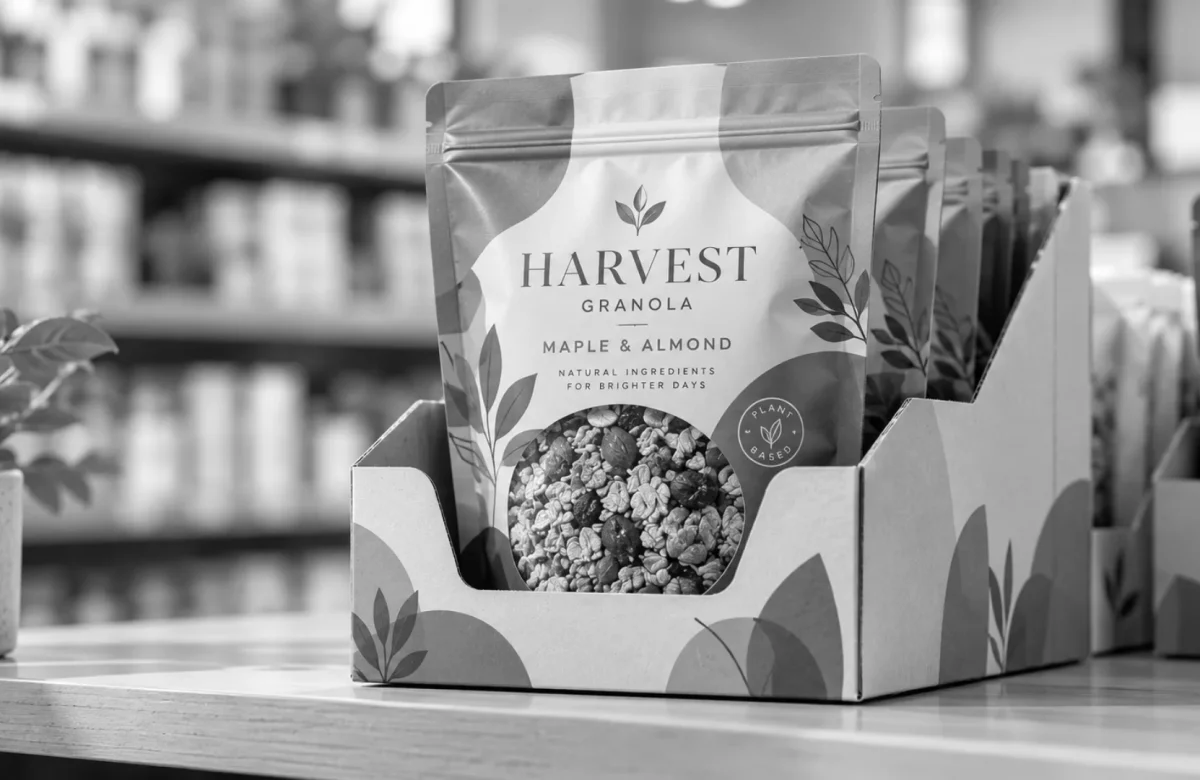
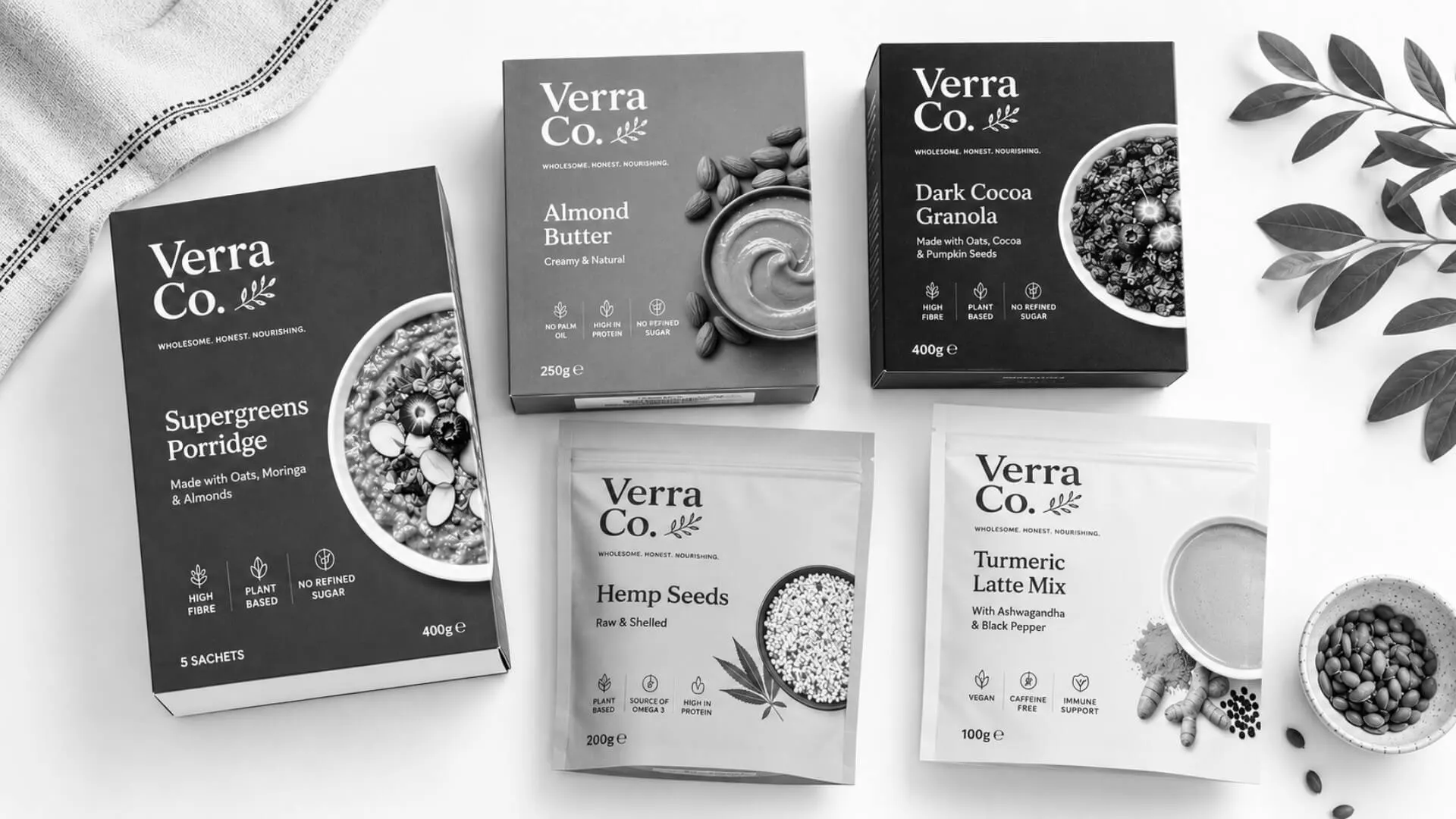
FMCG packaging design is the process of creating visual and structural packaging for fast-moving consumer goods that compete on retail shelves. It combines graphic design, print specifications, and brand strategy to produce packaging that stops shoppers, communicates product value, and drives purchase decisions within seconds.
Key Takeaways
• FMCG packaging is not just about aesthetics. It has to perform across shelf display, transit, and retail restocking without losing visual impact.
• Colour, typography, and hierarchy are the three design elements that determine whether a shopper picks up your product or walks past it.
• Consistency across your full product range matters as much as any single pack design. A fragmented range looks unplanned and undermines brand trust.
• Australian FMCG brands need to meet APCO’s 2025 National Packaging Targets, which require all packaging to be reusable, recyclable, or compostable.
• File preparation for print is where many small product brands lose money. Getting your print-ready files wrong the first time means reprints, delays, and wasted budget.
Introduction
Walk through any supermarket aisle, and you’ll see the same challenge played out across thousands of products. Every single one is competing for three seconds of attention. Some get picked up. Most don’t.
The brands that consistently get picked up have one thing in common: their packaging design does the selling before anyone reads a single word on the label. If you’re still working out what packaging design actually is, it comes down to the visual and structural choices that decide whether a product gets noticed and picked up off a shelf. That’s what good FMCG packaging design means in practice for fast-moving consumer goods.
This guide covers what you need to know about designing packaging for fast-moving consumer goods in the Australian market. Whether you’re launching a new product, refreshing an existing range, or trying to land shelf space in Woolworths or Coles, the principles here apply.
What makes FMCG packaging design different from standard packaging?
FMCG packaging design operates under tighter constraints than most other design categories, and understanding those constraints is what separates packaging that performs from packaging that just looks good.
Standard product packaging might need to work on your website, in a few retail boutiques, or in a direct-to-consumer setting. FMCG packaging has to survive a warehouse, a distribution centre, a pallet drop, and then compete on a shelf where it sits next to ten similar products at eye level.
That environment changes everything about how you approach the design. You’re not designing for a clean white backdrop. You’re designing for a cluttered, brightly lit supermarket shelf where your product has about three seconds to register with a shopper who is moving quickly and probably distracted. Understanding why packaging design matters for brand growth makes it clear why getting this right from the start is worth the investment.
According to research from the Package Design Research Institute, consumers make a purchasing decision within four to seven seconds of seeing a product on the shelf. That’s the window your packaging has to work in every single time.
How does colour affect FMCG packaging performance?
Colour is the first signal a shopper receives, and it works before they’ve consciously looked at your product.
In FMCG packaging design, colour serves two purposes. First, it helps shoppers find your product category quickly. Certain colours have strong category associations, think the blues and whites common in dairy, the greens used across health and organic products, and the bold reds and yellows in snack foods. Working with those associations makes it easier for shoppers to locate your product in the right aisle.
Second, colour differentiates your brand within the category. If every other product in your category uses pale green, a strong, deep navy, or a warm terracotta, it can make your product stand out immediately. The risk of ignoring what competitors are doing is that you either blend in completely or clash in a way that feels unintentional.
Colour also has to hold up in print. The colour you see on screen in CMYK is not always what comes off the press. A good packaging designer works with your printer early to confirm that your brand colours are achievable in the print process you’re using, whether that’s offset lithography, digital print, or flexographic printing for flexible packaging.
What role does typography play in shelf presence?
Typography on FMCG packaging is functional first and expressive second.
Your product name needs to be readable at the distance a shopper is standing from the shelf, typically 60 to 90 centimetres away. Your key claims, whether that’s “high protein,” “Australian made,” “100% natural,” or a flavour descriptor, need to be visible without the shopper picking the product up.
The hierarchy of information on an FMCG pack follows a clear order. Product name comes first, then the category descriptor, then the key benefit or claim, then the supporting detail. Everything else is secondary.
Where brands go wrong is trying to say too much. An FMCG pack that is dense with text pushes shoppers away. The packs that perform on shelf are the ones that communicate their core message in a single glance and save the detail for the back panel where it belongs.
Font choice also carries brand personality. A bold condensed sans-serif reads as strong and direct. A flowing script reads as artisan or handcrafted. A clean geometric font reads as modern and premium. Those signals happen instantly and unconsciously, so choosing the wrong font for your positioning costs you shelf credibility even when your product is excellent. Colour and typography are just two pieces of it. For a full walkthrough of how to design packaging step by step, from concept through to print-ready files, see our guide on how to design product packaging that attracts customers and boosts sales.
Why does range consistency matter for FMCG brands?
A single well-designed pack is not enough. The real power of FMCG packaging design comes from how your full product range presents as a family on the shelf.
When a shopper sees three, five, or ten of your products displayed together, the consistency of that range creates a visual block that is far more powerful than any individual pack. It signals that your brand is established, intentional, and worth trusting.
This is why brand identity design and packaging design should never be treated as separate projects. Your packaging range needs to be built on the same visual foundations as your broader brand. The same colour palette, the same typography system, the same design logic applied consistently across every SKU.
Range inconsistency is one of the most common problems we see with product brands that have grown organically. They launched with one pack design, added a new variant two years later with a different designer, then added another variant after that. The result is a shelf presence that looks piecemeal and makes the brand feel smaller and less credible than it actually is.
If your range has grown without a consistent design system behind it, a packaging refresh is worth considering before you push for new retail listings.
What do Australian FMCG brands need to know about packaging compliance?
Compliance requirements for FMCG packaging in Australia are tightening, and brands that get ahead of them now avoid costly redesigns later.
The Australian Packaging Covenant Organisation (APCO) has set National Packaging Targets that require all packaging made, used, and sold in Australia to be 100% reusable, recyclable, or compostable. According to Grocery Trade News, brands that fail to meet these requirements risk losing listings or facing tighter reviews during range resets at major retailers.
Beyond sustainability, Australian food packaging must also comply with mandatory labelling requirements, including country of origin declarations, nutritional information panels, and allergen warnings under Food Standards Australia New Zealand (FSANZ) guidelines.
These requirements are not design afterthoughts. They need to be factored into your packaging design from the very beginning, because they affect how much space is available for branding, where key information panels need to sit, and what size your text needs to be to meet legibility requirements.
Working with a design agency that understands Australian packaging compliance means you avoid the cost and delay of redesigning a pack because a mandatory element was overlooked.
What are the print production requirements for FMCG packaging?
Getting your packaging design right is only half the job. Getting it print-ready is where a lot of product brands lose time and money.
FMCG packaging goes through more demanding print processes than most other printed materials. Depending on your packaging format, you might be using flexographic printing for flexible pouches and films, offset lithography for cartons and labels, or digital print for short-run prototypes and seasonal variants.
Each print process has different requirements for file setup, colour mode, bleed allowances, and material specifications. A file that works perfectly for one process will often fail for another.
The most common mistakes product brands make with print-ready packaging files include using RGB colour values instead of CMYK, not supplying die-cut templates from the printer before the design is finalised, missing the required bleed and safe zone margins, and using low-resolution images that print poorly at production scale.
Saga Designs works directly with Australian printers and packaging suppliers to make sure every file we deliver is production-ready. That means fewer surprises, faster turnaround times, and packaging that looks on the shelf exactly as it did in the design presentation.
For brands that also need print services alongside their packaging design, having both managed through a single agency removes the back-and-forth that normally slows production down.
How do 3D mockups and product visualisation support FMCG packaging?
Before your packaging goes to print, you need to see it in the real world. That’s where 3D product visualisation becomes genuinely useful for FMCG brands.
A flat design file shows you what your label or carton looks like as artwork. A 3D mockup shows you what it looks like as a product on a shelf, in a photograph, on your website, and in a retail buyer presentation.
For product brands pitching to retail buyers at Woolworths, Coles, IGA, or independent retailers, a professional 3D render of your product can be the difference between a listing and a rejection. Retail buyers review hundreds of products. The ones that arrive with high-quality visual presentations look more credible and more ready for the shelf.
3D product modeling also allows you to explore multiple packaging variants without committing to a print run. You can test different colourways, label layouts, or structural formats and get a realistic sense of how each option performs visually before spending money on production.
Frequently Asked Questions
What is FMCG packaging design?
FMCG packaging design is the creation of visual and structural packaging for fast-moving consumer goods. It covers the graphic design applied to labels, cartons, pouches, and other packaging formats used by product brands selling through supermarkets, grocery stores, and retail channels. The goal is to attract shopper attention, communicate product value clearly, and drive purchase decisions at the point of sale.
How is FMCG packaging design different from regular product packaging?
FMCG packaging has to perform in a retail environment where products compete directly on the shelf against dozens of similar items. It must work at a viewing distance of 60 to 90 centimetres, communicate key information within three to seven seconds, survive distribution and warehousing, and meet Australian mandatory labelling requirements. Regular product packaging may not face all of these constraints at once.
What file formats does FMCG packaging need to be delivered in?
FMCG packaging files should be delivered as print-ready PDFs with CMYK colour values, correct bleed and safe zone margins, and all fonts outlined. Vector source files in AI or EPS format should also be supplied so the design can be resized or adapted for different pack formats. Your printer should provide a die-cut template before the design is finalised so the artwork is built to the correct structural dimensions.
How important is packaging consistency across a product range?
Range consistency is one of the most important factors in FMCG shelf performance. When your products display as a cohesive visual family, they create a stronger shelf presence than any individual pack can achieve alone. Inconsistency across a range of signals a lack of brand planning to both shoppers and retail buyers, which can make it harder to secure or retain listings.
Do Australian FMCG brands need to meet packaging sustainability requirements?
Yes. The Australian Packaging Covenant Organisation (APCO) has set national targets requiring all packaging to be reusable, recyclable, or compostable. These requirements affect material selection and packaging structure, and brands that fail to demonstrate progress risk losing shelf space at major retailers during range reviews. These requirements should be discussed with your packaging designer at the briefing stage, not after the artwork is complete.
How long does FMCG packaging design take in Australia?
A standard FMCG packaging design project typically takes four to eight weeks from initial briefing to print-ready files. This covers the design development, revision rounds, and print file preparation. If your project includes 3D visualisation, a full product range, or new structural packaging development, the timeline will be longer. Rushing the design phase to meet a launch date is one of the most common causes of costly reprints.
Conclusion
FMCG packaging design is one of the highest-leverage investments a product brand can make. It works every day, on every shelf, in front of every shopper who walks past your category. Getting it right means more than a good-looking label. It means a design that performs in a real retail environment, holds up across your full product range, meets Australian compliance requirements, and arrives at your printer ready to produce without surprises.
If you’re launching a new product or refreshing an existing range, Saga Designs works with product brands across Melbourne and Australia to create FMCG packaging that is built to perform on shelf. Get in touch and let’s talk about your packaging project.