TL;DR:
Custom signage is professionally designed, brand-specific signage created to reflect a business’s identity, audience, and location. Unlike generic signs, it is tailored using your logo, colors, fonts, and messaging, then strategically designed, fabricated, and installed for maximum impact. Businesses use custom signage to increase visibility, strengthen brand recognition, improve customer experience, and generate long-term return on investment.
Why Custom Signage Matters for Modern Businesses
Walk past any busy commercial street and you will immediately notice something: some businesses attract attention effortlessly, while others blend into the background. Often, the difference is not pricing or product quality. It is signage.
Many business owners ask, “What is custom signage?” because they want to understand whether it is worth investing in something beyond a simple printed board. With competition increasing in retail, hospitality, healthcare, education, and professional services, visual identity in physical spaces matters more than ever.
Customers make decisions quickly, effective signage directly influences purchasing behavior and brand recall. Poor signage, on the other hand, can reduce perceived credibility.
In this guide, you will learn what custom signage really means, how it works, why businesses rely on it, how to implement it step by step, and how it compares to standard signage. This is a complete, structured reference designed for clarity and practical use.
What Is Custom Signage?
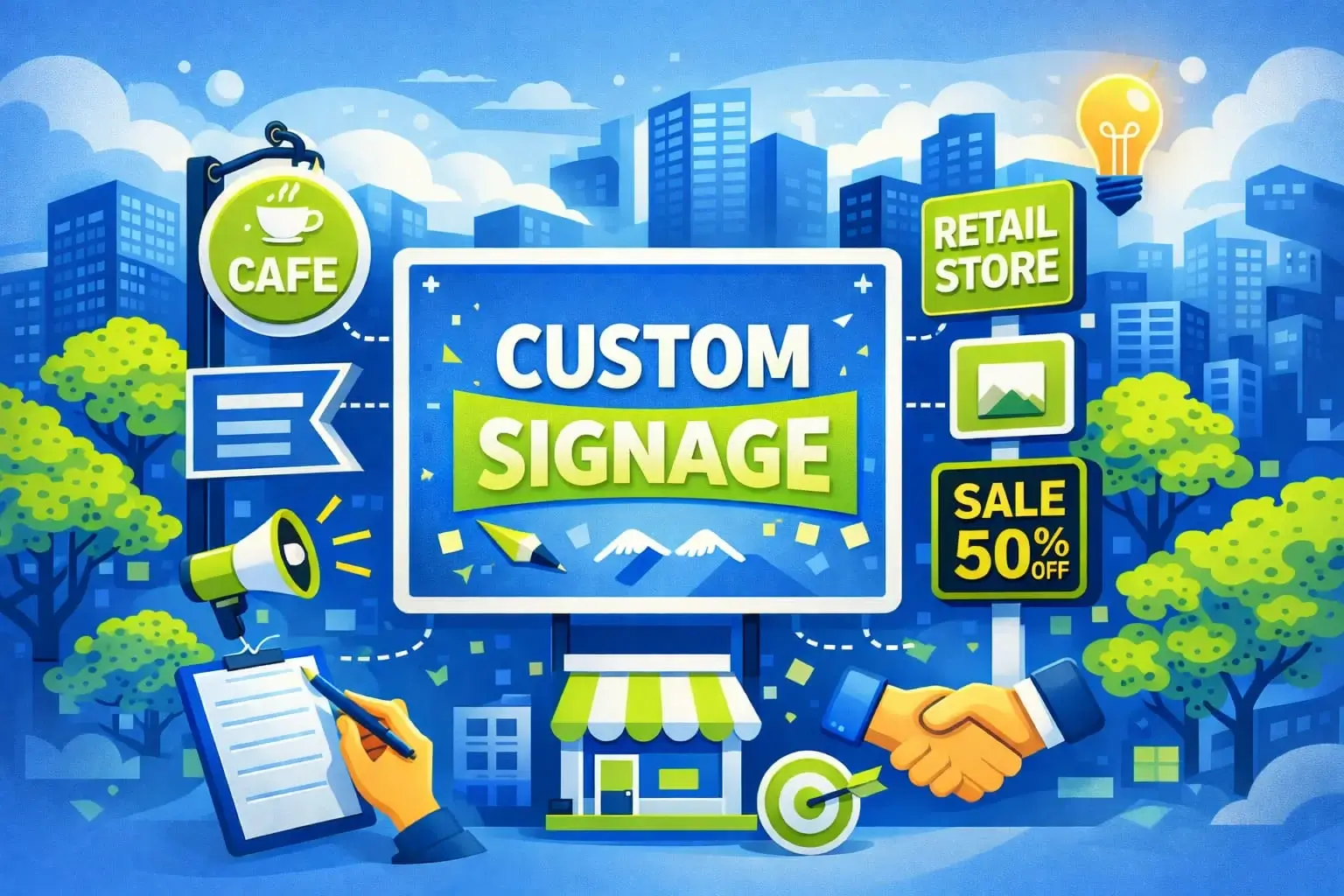
Custom signage refers to business signs that are uniquely designed and fabricated to reflect a specific company’s brand identity, space requirements, and communication goals.
Unlike off-the-shelf signs, custom signage includes:
- Tailored dimensions
- Brand-aligned typography
- Specific color systems
- Material selection based on environment
- Lighting integration when needed
- Strategic placement for visibility
It is not just decoration. It is branded communication.
Why Businesses Need Custom Signage
1. Visibility Drives Traffic
For physical businesses, visibility equals opportunity. A well-designed storefront sign increases recognition from a distance and improves walk-in traffic.Exterior improvements, including signage, influence consumer perception and foot traffic in retail districts.
2. First Impressions Shape Trust
Customers often form opinions within seconds. Professional custom signage signals legitimacy and stability. Poor or generic signage can suggest inexperience.
3. Brand Consistency Builds Memory
Repeated exposure to consistent visual identity strengthens brand recall. Custom signage aligns with your logo, website, packaging, and marketing materials.
4. Customer Experience Improves
Wayfinding signage, directional systems, and interior branding reduce confusion and create a smoother environment.
Why This Matters in 2026
Modern customers move between digital and physical experiences. They may discover a business online but visit in person. If your in-store branding does not match your digital identity, trust breaks.
Custom signage bridges that gap.
In competitive markets, differentiation is not optional. It is necessary.
How Custom Signage Works
Custom signage is a structured process, not a one-step purchase.
Step 1: Discovery and Strategy
This stage defines objectives:
- Is the goal visibility, branding, navigation, or promotion?
- Who is the target audience?
- What feeling should the signage evoke?
Strategic clarity prevents expensive redesigns later.
Step 2: Concept and Design
Designers create mockups that show:
- Layout
- Typography hierarchy
- Color contrast
- Lighting effects
- Scale relative to building
Readability is tested at different distances.
Actionable Tip:
Ensure letter height matches viewing distance. A common rule is one inch of letter height for every 10 feet of viewing distance.
Step 3: Material Selection
Common materials include:
- Acrylic
- Aluminum
- Stainless steel
- PVC
- Vinyl
- LED modules
Exterior signage requires weather-resistant materials. Interior signage may prioritize aesthetics.
Step 4: Fabrication
The approved design moves into production. Precision cutting, painting, wiring (if illuminated), and assembly occur during this stage.
Quality control is critical.
Step 5: Installation
Professional installation ensures:
- Structural safety
- Compliance with local regulations
- Electrical safety for illuminated signs
This is why many brands choose structured custom signage solutions for businesses that cover everything from concept to compliant installation.
Custom Signage vs. Standard Signage
Many businesses compare custom signage to template or generic signage.
| Feature | Custom Signage | Standard Signage |
| Branding | Fully aligned | Limited |
| Materials | Flexible | Restricted |
| Impact | High | Moderate |
| Cost | Higher upfront | Lower upfront |
| Long-Term ROI | Stronger | Weaker |
Standard signage may serve short-term needs. Custom signage builds brand equity.
Real-World Examples
Example 1: Retail Storefront
A clothing boutique upgraded from a flat printed board to 3D illuminated channel letters with brand-consistent typography.
Results within six months:
- Increased foot traffic
- Stronger social media photo visibility
- Improved brand recall among local shoppers
Example 2: Corporate Office Interior
A consulting firm installed a custom acrylic lobby logo with backlit LED halo lighting.
Impact:
- More professional first impression
- Better client perception
- Enhanced brand credibility during meetings
Use Cases Across Industries
Custom signage is used by:
- Retail stores
- Restaurants
- Healthcare clinics
- Educational institutions
- Gyms
- Real estate agencies
- Corporate offices
- Trade show exhibitors
Each industry adapts signage differently, but the objective remains visibility and brand communication.
Pros and Cons of Custom Signage
Pros
- Strong brand identity
- Increased visibility
- Long-term durability
- Enhanced customer experience
- Competitive differentiation
Cons
- Higher initial investment
- Longer production timeline
- Requires strategic planning
When planned properly, benefits outweigh limitations.
Common Mistakes Businesses Make
- Choosing price over durability
- Ignoring readability at distance
- Overcrowding text
- Inconsistent branding
- Skipping permit research
Working with experienced signage specialists who understand branding, materials, and compliance reduces these risks and ensures long-term durability and brand consistency.
Best Practices for Effective Custom Signage
Keep messaging simple.
Prioritize legibility over decoration.
Use contrast wisely.
Match signage style to brand personality.
Confirm compliance with local zoning laws.
Pro Insight:
Lighting temperature affects perception. Warm lighting feels welcoming. Cool lighting feels modern and corporate.
FAQ Section
Q: What is custom signage in simple terms?
A: Custom signage is a personalized business sign designed specifically using a company’s logo, colors, fonts, and messaging. Unlike generic signs, it is tailored to match the brand identity and the physical location where it is installed.
Q: What is the purpose of custom signage?
A: The purpose of custom signage is to communicate a business’s brand identity, attract attention, and provide clear information in physical spaces. It helps increase visibility, improve customer navigation, and strengthen brand recognition.
Q: How much does custom signage cost?
A: Custom signage costs vary based on size, materials, lighting, and installation requirements. Small indoor signs may start in the hundreds, while large illuminated exterior signage can range from several thousand dollars depending on complexity.
Q: Is custom signage worth the cost?
A: Custom signage is worth the cost when aligned with business goals. It improves storefront visibility, builds long-term brand recognition, enhances customer trust, and can increase foot traffic, which supports stronger return on investment over time.
Q: How long does custom signage last?
A: Custom signage typically lasts between 5 to 10 years, depending on materials, environmental exposure, and maintenance. Metal and acrylic signs tend to last longer outdoors, while interior signage may last even longer with proper care.
Key Takeaways
- Custom signage is brand-specific visual communication.
- It improves visibility and brand recognition.
- The process includes strategy, design, material selection, fabrication, and installation.
- It offers stronger long-term ROI than generic signage.
- Proper planning prevents costly mistakes.
Conclusion
Custom signage is more than a visual accessory. It is a strategic branding asset that influences perception, trust, and customer behavior. Businesses that invest in well-designed signage often stand out in competitive environments and build stronger brand recall over time.
If you are evaluating signage options, begin with strategy rather than materials. Define your goals, understand your audience, and design intentionally. When done correctly, custom signage becomes a long-term business advantage.
At SAGA Designs, you can explore our signage services to see how strategy, design precision, and quality fabrication come together to create impactful business signage that lasts. For deeper learning, explore related guides on brand identity systems, logo design strategy, and visual marketing fundamentals to build a cohesive presence across all touchpoints.