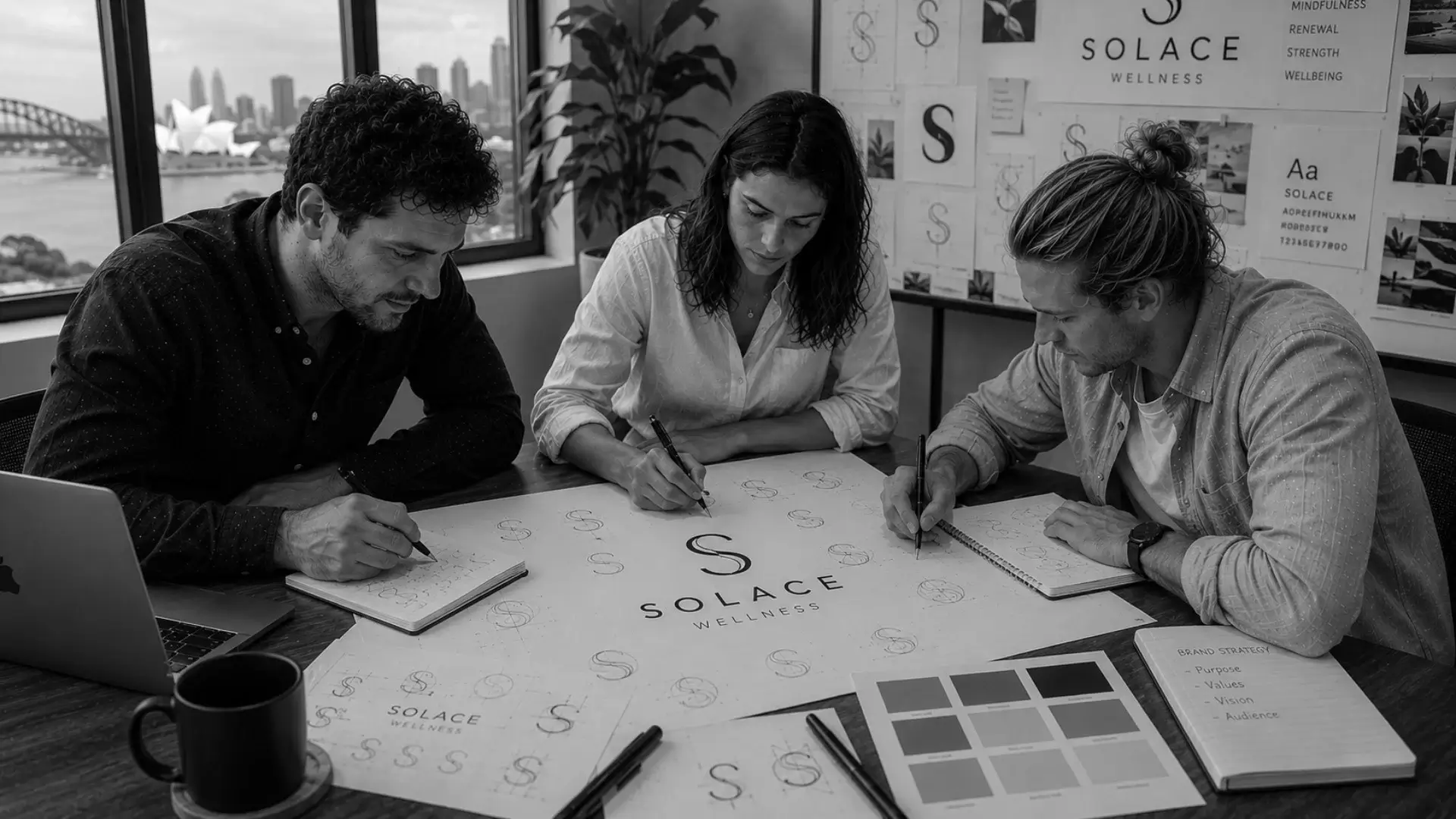
A good logo design combines simplicity, the right typography, intentional colour, scalability, relevance to the brand, originality, and timelessness. When these elements work together, your logo does real commercial work: it builds recognition, signals trust, and gives customers something to associate with your business across every touchpoint.
When someone asks what makes a logo good, most people reach for words like “clean” or “modern.” But those are descriptions of style, not structure. A logo can look current and still fail at the job it is supposed to do.
The real question is whether your logo works. Does it get recognised? Does it communicate the right things about your business? Does it hold up on a vehicle wrap, a packaging label, and a website favicon, all at the same time?
These are questions about elements, not aesthetics. And getting the elements right is what separates a logo that lasts from one that needs to be replaced the moment your business grows past a certain point.
This guide covers the essential elements every good logo needs, why each one matters, and what to watch out for when you are having a logo designed for your business.
Key Takeaways
- Simplicity is the foundation of every effective logo. The more complex it is, the harder it is to remember, reproduce, and use across different formats.
- Typography communicates personality before anyone reads a word. The wrong font sends the wrong signal about your business.
- Colour is the fastest signal your logo sends. Your colour choice must also work in black and white, not just on screen.
- Scalability means your logo stays clear from a 16-pixel favicon to a five-metre building sign. If it fails at small sizes, it is not a finished logo.
- Timelessness matters more than trends. A logo built around what is fashionable will need an expensive rebrand within a few years.
- Originality is not about being different for its own sake. A logo that looks like a competitor’s creates confusion, not recognition.
Why does simplicity matter so much in logo design?
Simplicity is the foundation of effective logo design because a logo needs to be recognised instantly, at any size, in any context.
The more complex a logo is, the harder it is to remember, reproduce, and use consistently. Fine details disappear at small sizes. Intricate shapes get lost on signage viewed from a distance. Busy compositions look messy when reduced to a social media profile picture.
Think about the logos that have become genuinely iconic over time. Nike. Apple. McDonald’s. All of them are simple enough to draw from memory after seeing them once. That is not a coincidence. It is a deliberate design decision.
For Australian small and medium businesses, simplicity matters even more because your logo will live across a wide range of applications: a shopfront sign on a busy street, a vehicle wrap viewed while driving, a business card handed over in a meeting, and a profile picture on a phone screen. Each of those contexts demands clarity. A complex logo fails in at least one of them.
Simplicity does not mean boring. It means removing everything that is not essential and making sure what remains does real work.
How does typography shape what a logo communicates?
Typography is the voice of your logo. Before anyone reads your business name, the style of the font has already communicated something about who you are.
A serif font signals tradition, reliability, and establishment. This is why law firms, financial institutions, and heritage brands typically use serif typography in their logos. A sans-serif font signals modernity, clarity, and accessibility. A script font signals creativity, elegance, or handcraft. A bold display font signals energy, confidence, and directness.
None of these is right or wrong. The question is whether the typography matches the personality of your business and the expectations of your customers.
The practical rules are straightforward. Your logo font must be legible at small sizes, which rules out anything overly decorative or condensed. It must work in a single colour, including black and white. And it should be distinctive enough not to look identical to every other business in your category.
Custom typography, or a commercially licensed font that has been modified for your brand, gives you something competitors cannot replicate with the same typeface. For businesses investing seriously in their brand, this is worth considering from the start rather than as an afterthought.
If you are working on the visual foundation of your brand, our brand identity design services can help you develop typography that works across your logo, your printed materials, and your digital presence.
What role does colour play in logo design?
Colour is the fastest signal your logo sends. Research from the Stanford Graduate School of Business found that colour can increase brand recognition by up to 80%. That is how much work your colour choice is doing before a single word is read.
Different colours carry different associations, and while these vary somewhat by culture and context, some patterns are consistent enough to be useful as starting points:
Blue communicates trust, reliability, and professionalism. It is the dominant colour in financial services, healthcare, and technology for this reason.
Red communicates energy, urgency, and appetite. This is why it appears so heavily in food brands and retail.
Green communicates health, nature, and growth. It works well for wellness, sustainability, and agricultural businesses.
Black communicates premium quality, authority, and sophistication. Luxury brands and high-end service businesses use it deliberately.
Yellow communicates warmth, optimism, and accessibility. It is attention-grabbing and works well for businesses wanting to feel approachable.
The practical decision for most businesses is to choose one or two primary colours and one neutral. Two-colour combinations make up around 43% of all logos for good reason: they create enough visual interest without adding complexity or reproduction challenges.
Your logo colours also need to work in black and white. This is not a hypothetical. Your logo will appear on fax confirmations, legal documents, stamps, embossed stationery, and laser-printed materials. If it only works in colour, you have a logo that fails in a predictable set of real-world situations.
What does scalability mean for a logo, and why does it matter?
Scalability means your logo remains clear, legible, and recognisable at every size it will ever be used, from a 16×16 pixel browser favicon to a five-metre-wide building sign.
This is a technical and design requirement that gets ignored surprisingly often, especially when logos are designed by people who work primarily in digital formats. A logo that looks sharp at 400 pixels wide can completely fall apart at 16 pixels. Fine lines disappear. Text becomes unreadable. The whole thing turns into a blob.
The solution is designing for scalability from the start rather than trying to fix it later. This means:
Using vector files (AI, EPS, SVG) rather than raster files (JPG, PNG) as the master artwork. Vector files scale to any size without losing quality.
Keeping fine details, thin lines, and small text out of the core mark. These are the first things to fail at small sizes.
Creating simplified versions of the logo for small-scale use. Many professional logos have a primary version for large applications and a simplified icon version for small applications like app icons and favicons.
At SAGA Designs, every logo we produce is delivered in full vector format with size variations included. A logo that cannot scale is not a finished logo, regardless of how good it looks on a presentation slide.
How important is brand relevance in logo design?
A logo needs to feel right for the industry, the audience, and the specific personality of the business it represents.
Relevance is not about being generic to your industry. It is about being clearly positioned within it. A children’s education brand and a law firm operate in completely different audience territories. A logo that works for one would be completely wrong for the other, and the difference comes down to how relevant the design choices are to the specific context.
For Australian businesses, relevance also means thinking about the specific market and customer base you are serving. A brand targeting inner-city Melbourne professionals has different visual expectations than one targeting regional Queensland trade businesses. Both deserve logos that feel right to their specific customers.
This is why a brief is the most important part of any logo design project. Understanding who the business is for, what it does, and how it wants to be perceived gives a designer the information needed to make relevant choices about typography, colour, shape, and style.
A logo that looks like it belongs to a different industry than the one it represents creates a gap between expectation and reality. That gap costs you customers, before they have heard a single thing about your actual product or service.
Why does originality matter in a logo?
Originality means your logo is clearly distinct from competitors in your category. It is not about being different for the sake of it. It is about giving your customers something specific to associate with your business rather than your industry in general.
When two logos in the same category look similar, the smaller or newer brand almost always loses. Customers associate the familiar-looking logo with the brand they already know. If your logo could pass for a competitor’s at a glance, you are spending your brand-building effort making your competitor more recognisable.
This is also a practical legal issue. Logos that are too similar to existing registered trademarks can create intellectual property problems that are expensive to resolve after the fact. Originality from the start avoids this entirely.
For Australian businesses, originality does not require an eccentric or unusual design. It requires a clear understanding of what everyone else in your category is doing visually, and a deliberate decision to occupy different visual territory. Sometimes that is a colour no one else is using. Sometimes it is a typographic approach that is distinctly yours. Sometimes it is a mark or symbol that is genuinely unique.
Our logo design services always start with competitive research in your specific market before a single concept is developed. That research is what makes originality achievable rather than accidental.
What makes a logo timeless rather than trendy?
A timeless logo will still look appropriate and effective in ten or fifteen years without a major redesign.
Trends in logo design come and go quickly. The flat design trend of the 2010s has already started to feel dated. The gradients and drop shadows of the early 2000s are now associated with a specific era rather than a specific brand. A logo that leans heavily on whatever is fashionable at the time it was designed will carry that timestamp permanently.
Timelessness does not mean boring. The logos that have stood the test of time tend to be the ones built around clear, confident design decisions that were right for the brand rather than right for the moment.
Practical ways to build timelessness into a logo:
Avoid effects that are associated with specific software eras, such as lens flares, heavy drop shadows, and complex gradients. These dates quickly.
Choose typography based on brand fit rather than current popularity. A typeface that is everywhere right now will feel overused within a few years.
Build the mark around a concept that is meaningful to the business rather than a visual trend. Meaning does not expire.
Test the logo against older design sensibilities as well as current ones. If it had looked reasonable fifteen years ago and looks appropriate now, it has a good chance of lasting.
A logo is a long-term investment. Replacing it costs money, disrupts recognition that has been built over time, and requires updating every place it appears. Getting it right from the start is almost always cheaper than getting it trending.
Frequently Asked Questions
What are the most important elements of a good logo for a small business in Australia?
The most important elements are simplicity, relevant typography, intentional colour, and scalability. For Australian small businesses specifically, the logo also needs to work across physical signage, print materials, digital channels, and increasingly product packaging. A logo that handles all of those environments reliably is more valuable than one that looks impressive only on screen.
How many colours should a business logo have?
Most professional logos use one or two primary colours plus a neutral. Two-colour combinations make up approximately 43% of all logos because they create visual interest without adding reproduction complexity. More importantly, your logo must also work in a single colour, including black and white, for use on documents, stamps, and certain print applications.
What is the difference between a timeless logo and a trendy one?
A timeless logo is built around design decisions that are right for the brand rather than the moment. It avoids effects, typography choices, and visual styles that are associated with a specific design era. A trendy logo reflects what is fashionable at the time it was made and typically needs a redesign within five to ten years. For most businesses, a timeless logo is a far better investment.
How do I know if my logo is too complex?
Test it at very small sizes. If the logo is hard to read or the details become unclear at the size of a social media profile picture (around 200×200 pixels), it is too complex for reliable real-world use. Also, try reproducing it in a single colour. If details disappear or the logo looks poor in black and white, simplification is needed.
Should my logo reflect my industry visually?
It should feel relevant to your industry and your specific audience, but it should not look identical to every other brand in your category. Relevance means being clearly positioned within your market. Originality means occupying a distinct visual territory within it. Both matter, and neither cancels out the other.
How long should a logo last before it needs to be updated?
A well-designed logo built on timeless principles should serve a business for ten to fifteen years before needing more than a minor refinement. Logos that need significant redesigns after five years or fewer are typically ones that were built around trends, were not designed for scalability, or no longer accurately reflect a business that has changed significantly. Investing in getting the fundamentals right from the start is far more cost-effective than repeated redesigns.
Conclusion
A good logo is not just one that looks nice on the day it is created. It keeps working reliably across every application your business needs, every year your business operates.
Simplicity, typography, colour, scalability, relevance, originality, and timelessness are not a checklist. They are interdependent. A logo that is simple but irrelevant fails. A logo that is original but not scalable fails in practical use. Getting all seven elements right, together, is what a professional logo design process is built to achieve.
Australian businesses investing in their brand deserve a logo that can carry that investment forward. If you are starting from scratch or replacing something that is no longer working, SAGA Designs works with businesses across Melbourne, Dandenong, and wider Australia to build logos that are built to last.
Get in touch to start the conversation about your logo.