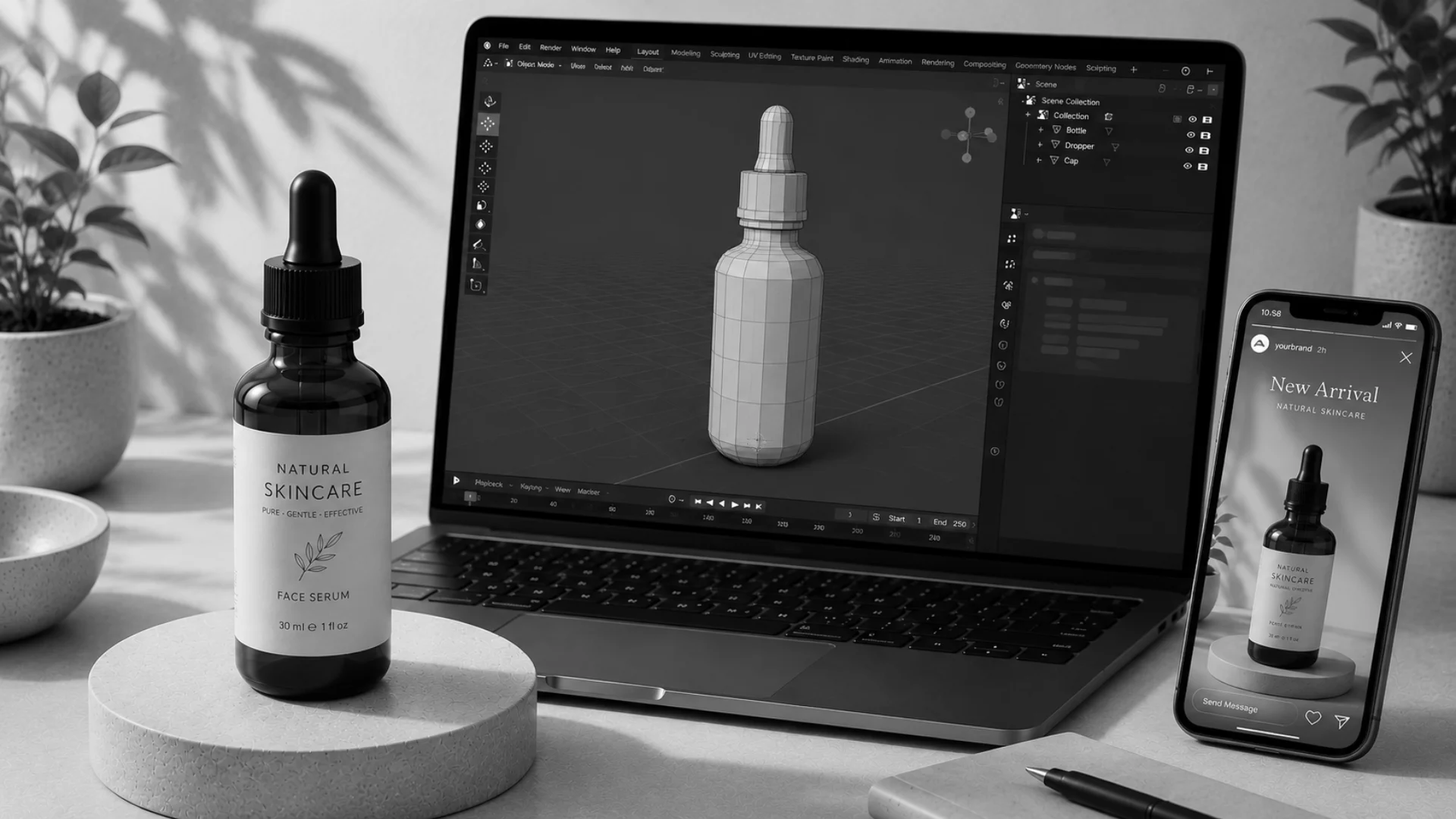
3D product modeling is worth it for small businesses, not just big brands. A small business selling online often benefits more from it than a large one, since it removes the cost of repeated photo shoots every time a product changes, and one model can be reused across a website, ads, and listings for years.
If you run a small business, it’s easy to assume 3D product modeling is something only big brands with big budgets use. That assumption isn’t quite right, and it’s worth clearing up properly.
The truth is a small business often has more to gain from it than a large one, since a small business usually can’t afford to keep booking new photo shoots every time something changes. One 3D model solves that problem once.
Key Takeaways
• 3D product modeling is not priced or built only for enterprise brands; small businesses use it too
• One 3D model replaces the need for a new photo shoot every time you add a colour or variant
• Poor product visuals are a real cost; consumers returned $428 billion worth of products in 2020 alone, according to Retail Dive
• DIY tools and cheap freelancers exist, but they trade time and consistency for a lower price
• Saga Designs builds 3D product models for small and growing businesses, not just large ones
Is 3D Product Modeling Actually Affordable for a Small Business?
Yes, 3D product modeling is genuinely affordable for a small business, and the cost usually depends on the complexity of the product rather than the size of the business buying it.
A single product with a straightforward shape costs less to model than a product with intricate moving parts or complex materials. Most small businesses paying for one product model are paying a similar rate to a large brand modelling one product; the price scales with the product, not the company.
Why Does 3D Modelling Help Small Businesses Specifically?
3D modelling helps small businesses specifically because it removes the repeated cost of photography, which hits a small budget much harder than a large one.
A big brand can absorb the cost of a new photo shoot for every seasonal colour release. A small business often can’t. Once a product is modelled in 3D, changing the colour, background, or angle takes minutes, not another booking with a photographer and a studio.
Poor product visuals also cost real money in a way that’s easy to underestimate. Consumers returned $428 billion worth of products in 2020 alone, at an estimated cost of $101 billion to the industry, according to Retail Dive. A clear, accurate product image, whether a photo or a 3D render, reduces the gap between what someone expects and what actually arrives.
Here’s what that difference actually looks like over a year for a small business adding a few new colours or variants.
| One 3D Model | Repeated Photo Shoots | |
| Upfront cost | One payment per product | One payment per shoot |
| Cost of a new colourway | Minutes to adjust, low or no extra cost | A new shoot, booked and paid for again |
| Turnaround for a new variant | Same day to a few days | Days to weeks, depending on availability |
| Usable across platforms | Yes, resized and adjusted freely | Often needs separate shots per platform |
| Ongoing cost as the range grows | Stays low | Grows with every new product |
A photo shoot is often cheaper the very first time. A 3D model usually becomes cheaper the second, third, and every following time a business needs a new angle, colour, or format.
Do All Small Businesses Actually Need This?
No, not every small business needs 3D product modelling, and it’s worth saying that plainly rather than pretending otherwise.
If you sell a single simple product, in one colour, with no plans to expand the range, and you’re not selling on multiple platforms with different image requirements, a single good photo shoot may genuinely cover everything you need. 3D modelling earns its cost back through reuse, and if there’s nothing to reuse it for, that value doesn’t materialise. The honest answer is that this service makes the most sense once a product range starts growing, not before.
When Does It Make the Most Sense for a Small Business?
3D modelling makes the most sense for a small business when the product has several variants, when a physical sample doesn’t exist yet, or when the product is difficult to photograph well.
If you sell one simple product in one colour, a single good photo shoot might genuinely be enough. But if you’re launching several colourways at once, selling something with intricate detail a camera struggles to capture cleanly, or trying to get your store live before your first shipment arrives, a 3D model solves problems photography can’t.
Can I Just Do This Myself to Save Money?
You can build a basic 3D model yourself using free software like Blender, or hire a low-cost freelancer through a platform like Fiverr, and both are genuinely real options worth knowing about.
Here’s the honest trade-off. Learning Blender well enough to produce a clean, accurate model takes real time, often weeks, not an afternoon, and the learning curve is steep if you’ve never worked in 3D before. A cheap freelancer can be a good option, but quality and consistency vary a lot from one freelancer to the next, and revisions, ongoing support, and matching your existing brand work aren’t always included at a low price point.
Neither path is wrong. If your budget is genuinely tight and you have time to spend learning or managing a freelancer directly, both can work. If you’d rather have it done the first time properly, without spending your own hours on it, working with a design agency that builds 3D models as part of a broader, consistent brand system is usually the faster route.
Can I Reuse the Same 3D Model Across Everything?
Yes, a single 3D product model can be reused across your website, social media and ecommerce creatives, email marketing, and printed catalogues, often for years, without paying for a new shoot each time.
This is one of the clearest financial advantages for a small business specifically. A photo shoot produces a fixed set of images. A 3D model is a reusable asset you can pull new angles, colours, and backgrounds from whenever you need them.
In practice, that means a small business could use the same model for a hero image on the homepage, a square crop for an Instagram ad, a different angle for an email newsletter, a white background version for a marketplace listing, and a styled lifestyle render for a printed lookbook, all from one original file, without a single additional booking.
Frequently Asked Questions
Is 3D product modelling only for large companies?
No. 3D product modelling is used by businesses of every size. The cost is generally driven by how complex the product is to model, not by the size of the business commissioning the work.
How much does 3D product modelling cost for a small business?
Cost depends on the complexity of the product and how many renders or variations you need. Simple products typically cost less than products with intricate detail or moving parts. Contact a provider directly for a quote based on your specific product.
Is it cheaper to use a freelancer than an agency for 3D modelling?
Often, yes, upfront. But quality, consistency, and included revisions vary significantly between freelancers. An agency typically costs more but includes quality control and consistency with your existing brand work as part of the price.
Can I learn to make 3D product models myself for free?
Yes, using software like Blender, which is free. It genuinely takes real time to learn well, often several weeks of practice for a clean result, so weigh the time cost against what your time is worth to your business.
Will a 3D render look as good as a real photo?
A well-made 3D render can look identical to a photograph to most viewers. Quality depends entirely on the skill of whoever builds it; a poorly made render can look obviously fake, while a well-made one is very hard to tell apart from a photo.
Do I need 3D modelling if I only sell one product in one colour?
Not necessarily. If your range isn’t likely to grow and you don’t need images across multiple platforms with different requirements, a single professional photo shoot may cover everything you need. 3D modelling pays off most once there’s genuine reuse across variants, platforms, or future products.
Conclusion
3D product modelling isn’t reserved for big brands with big budgets; it’s genuinely one of the more cost-effective tools available to a small business, precisely because it removes the need for repeated photo shoots. Saga Designs builds 3D product models for small and growing businesses across Melbourne and Australia, scaled to fit your product and your budget. Get in touch for a free quote based on what you actually need.