
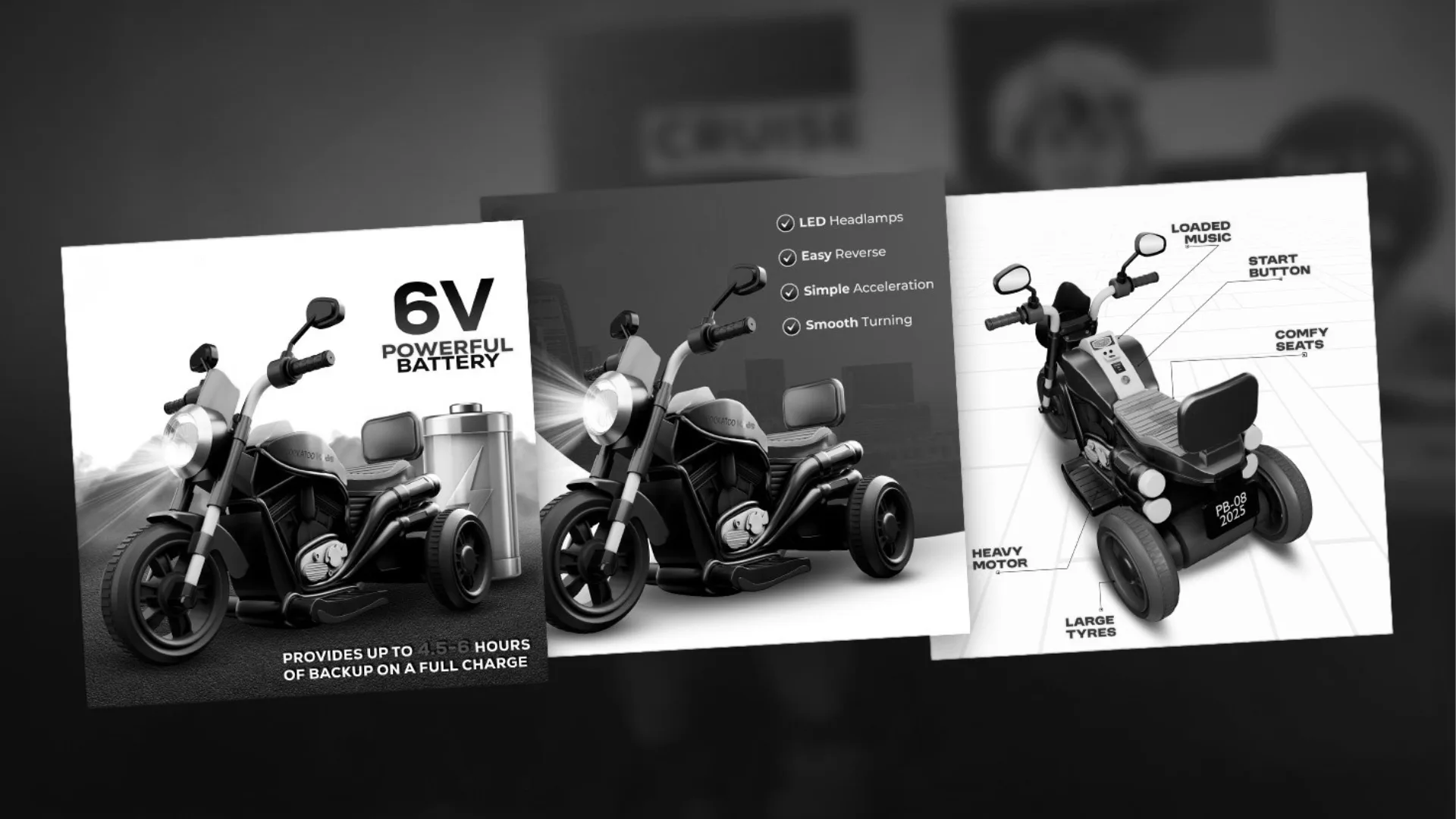
Yes, Amazon and Shopify both accept 3D product images, including CGI renders, provided they meet each platform’s image quality and technical specifications. Photorealistic 3D renders are now widely used by product brands on both platforms and are indistinguishable from traditional photography when produced to a professional standard.
A lot of product brand owners assume 3D renders are only for big brands or that ecommerce platforms won’t accept CGI images. Both of those assumptions are wrong.
If you sell on Amazon or run a Shopify store, 3D product modeling gives you a practical way to produce professional product images without a photoshoot, a physical sample, or the cost of reshooting every time you add a new variant.
But there are rules. Each platform has specific requirements about image quality, file format, background colour, and how accurately the product must be represented. This post covers exactly what those requirements are and what you need to know before commissioning 3D renders for your ecommerce listings.
Key Takeaways
• Amazon accepts photorealistic 3D renders for both main and secondary product images, as long as they accurately represent the actual product and meet Amazon’s standard image specifications.
• Shopify not only accepts 3D render images but natively supports interactive 3D models in GLB format, which allows shoppers to rotate and inspect products directly on the product page.
• 3D product images must meet the same quality standards as traditional photography on both platforms. Low-quality or obviously computer-generated renders that misrepresent the product can lead to listing suppression on Amazon.
• A single 3D model can produce images for Amazon, Shopify, social media, packaging mockups, and retail buyer presentations, making it one of the most reusable assets a product brand can invest in.
• Ecommerce sellers launching new products can use professionally produced 3D renders before a physical sample exists, allowing listings to go live the day inventory arrives rather than weeks later.
Does Amazon accept 3D product images?
Yes. CGI and photorealistic 3D rendered images are fully permitted on Amazon as long as they accurately represent the actual product and comply with all standard image guidelines, including the white background rule for main images.
Amazon does not require images to be traditional photographs. The platform’s image requirements describe output specifications, not production methods. A render that meets the technical specifications is treated identically to a photograph.
Here is what Amazon requires for product images in 2026:
Main image requirements
The main listing image must show the product on a pure white background (RGB 255, 255, 255). No text, logos, graphics, props, or watermarks are permitted. The product should fill at least 85 per cent of the image frame. Amazon recommends a minimum of 2,000 pixels on the longest side to enable the zoom function, which significantly affects conversion rates. Images must be supplied in JPEG, PNG, TIFF, or non-animated GIF format. JPEG is strongly preferred.
A 3D render on a white background is often sharper and more consistent than a photographic equivalent because every light source can be controlled precisely in the render. This is one area where professionally produced CGI frequently outperforms traditional photography.
Secondary image requirements
Secondary images have much more flexibility. They can show the product in a lifestyle setting, with size comparison references, with infographic overlays, in exploded or cutaway views, or in close-up detail shots. All of these can be produced from a single 3D model without additional photoshoots.
E-commerce sellers can produce a full nine-image Amazon listing set from one 3D model. We regularly produce complete image sets for product listings where the physical product is still in manufacturing. The listing goes live the day inventory arrives.
What Amazon does not allow
Renders that misrepresent the product’s colour, size, features, or materials in a way that could mislead buyers are prohibited. Discrepancies between the rendered image and the physical product that is shipped can lead to increased return rates and account suspension. The 3D render must be an accurate representation of what the customer receives.
Does Shopify accept 3D product images?
Yes, and Shopify goes further than Amazon by natively supporting interactive 3D product models directly on product pages.
Shopify supports 3D product models in GLB format, which allows merchants to display a fully interactive 360-degree view of products. Shoppers can rotate, zoom, and inspect the product from any angle directly on the product page without leaving the listing.
According to Shopify’s own research, products featuring 3D or AR content show, on average, a 94 per cent higher conversion rate compared to products with standard static images. Shoppers who interact with 3D or AR content are significantly more likely to complete a purchase because the interactive experience removes uncertainty about the product’s appearance, size, and finish.
For static product images on Shopify, there are no platform-specific restrictions on CGI or 3D renders. Shopify accepts any high-quality product image that accurately represents the product. The same quality standard applies: images must be professional, clearly lit, accurately coloured, and large enough to display well across desktop and mobile.
Shopify recommends images of at least 2048 x 2048 pixels for product images to ensure sharp display across all devices. For interactive 3D models in GLB format, file size should be kept under 15MB to ensure fast loading on mobile, where the majority of ecommerce browsing now occurs.
What image quality do 3D renders need for ecommerce?
3D product renders for ecommerce must meet the same visual quality standard as professional photography. The render needs to look like a real photograph of the product to perform on either platform.
The most common reason 3D renders fail on ecommerce platforms is not policy non-compliance but quality. Renders that look obviously computer-generated, have incorrect material textures, poor lighting, or inaccurate product geometry will underperform compared to professional photography, regardless of whether the platform technically accepts them.
What separates a professional render from a cheap one comes down to four things: accurate geometry that reflects the real product’s proportions and details, realistic material textures (metal should look like metal, matte plastic should look like matte plastic), controlled lighting that eliminates flat or artificial shadows, and correct colour matching to the actual product.
At SAGA Designs, every 3D product model we produce is built from accurate reference materials, dimensions, and brand colour specifications. The render is indistinguishable from a studio photograph of the physical product when done correctly.
What other channels can 3D product images be used on?
A professionally produced 3D product model is one of the most reusable assets an ecommerce brand can invest in. The same model that produces your Amazon and Shopify images can also be used across multiple other channels without any additional modelling cost.
Social media advertising: 3D renders work on Instagram, Facebook, TikTok, and Pinterest. They can be produced in any crop ratio for different formats, and colour variants can be generated from the same model at a fraction of the cost of reshooting.
Google Shopping: Google Shopping accepts CGI product images using the same quality guidelines as Amazon. Images must accurately represent the product and meet Google’s standard image quality requirements.
Packaging mockups: A 3D model of your product can be used to visualise how your product will look inside its packaging before the packaging goes to print. This is particularly useful for brands working on packaging design alongside their ecommerce imagery.
Retail buyer presentations: When pitching to buyers at Woolworths, Coles, or independent retailers, high-quality 3D renders make your product look shelf-ready before the first unit is manufactured. This is one of the strongest arguments for commissioning 3D models early in a product launch timeline.
Product colour variants: Once the base 3D model is built, generating images in additional colourways costs a fraction of reshooting. This is especially useful for fashion, homewares, and consumer product brands with multiple SKU variants.
If you’re also working on how to create a 3D product model for the first time, understanding the range of channels it can serve helps you brief the project correctly and get maximum value from the investment.
Is 3D product modelling worth it for Australian ecommerce sellers?
3D product modelling is worth it when your product has multiple colour variants, when you need images before a physical sample exists, or when repeated photoshoots are eating into your margins.
It is less compelling for brands with one or two SKUs, short product lifecycles, or products that require lifestyle photography with real people to drive conversions. Human-centric shots for baby products, pet products, or apparel with fit considerations still perform better with traditional photography in most cases.
For the majority of Australian product brands selling hard goods, consumer packaged goods, homewares, beauty, supplements, or accessories, 3D product modelling delivers a measurable return. According to 360 Render, clients regularly report 30 to 90 per cent cost savings by using CGI instead of traditional photoshoots once the base model is built and reused across campaigns.
The upfront investment in a quality 3D model pays for itself when the model is used across Amazon, Shopify, social media, retail presentations, and packaging mockups over the product’s commercial lifetime.
Frequently Asked Questions
Can I use a 3D render as the main image on Amazon?
Yes. Amazon accepts photorealistic 3D renders as the main listing image, provided the render shows the product on a pure white background, accurately represents the physical product, and meets Amazon’s technical image specifications, including a minimum of 2,000 pixels on the longest side. The render must not misrepresent the product’s colour, size, or features in any way that could mislead buyers.
Does Shopify support interactive 3D product models?
Yes. Shopify natively supports interactive 3D product models in GLB format. This allows shoppers to rotate and inspect products from any angle directly on the product page. Shopify’s research shows products with 3D or AR content achieve significantly higher conversion rates than those with static images only. File size for GLB models should be kept under 15MB for optimal mobile loading performance.
What file format do I need for 3D product images on Amazon?
Amazon accepts JPEG, PNG, TIFF, and non-animated GIF formats for product images. JPEG is strongly preferred for its balance of quality and file size. Images must be a minimum of 1,000 pixels on the longest side to enable the zoom function, with 2,000 pixels or more recommended. For the main listing image, the background must be pure white (RGB 255, 255, 255).
Can I get my Amazon and Shopify images from the same 3D model?
Yes. A single professionally produced 3D model can generate images for Amazon, Shopify, Google Shopping, social media, and retail buyer presentations. Different image crops, colour variants, lifestyle backgrounds, and secondary angles can all be produced from one base model. This is one of the strongest arguments for investing in 3D product modelling rather than traditional photography for brands with multiple variants or channels.
How realistic do 3D product renders need to be for ecommerce?
They need to be photorealistic. Both Amazon and Shopify require images that accurately represent the physical product. Renders that look obviously computer-generated or that do not accurately match the product’s colours, materials, or proportions will underperform in conversion rates, even if the platform technically accepts them. Professional renders should be indistinguishable from studio photography.
Can I launch my Amazon listing with 3D renders before I have physical stock?
Yes, and this is one of the most practical benefits of 3D product modelling for Australian sellers. A complete set of Amazon-ready images can be produced from a 3D model before the physical product is manufactured. This allows your listing to go live the day inventory arrives at the fulfilment centre, rather than weeks later after a photoshoot is organised and completed.
Conclusion
3D product images are accepted on Amazon and Shopify. The question is not whether you can use them, but whether they are produced to a quality standard that meets performance requirements.
When produced professionally, 3D renders are indistinguishable from photography, meet all platform requirements, and deliver far more flexibility than a photoshoot. The same model serves your Amazon listing, Shopify store, social media, packaging design, and retail buyer presentations.
Saga Designs produces 3D product models for ecommerce brands across Melbourne and Australia. If you’re launching a new product or looking to replace expensive photoshoots with reusable 3D assets, get in touch and let’s talk about your project.