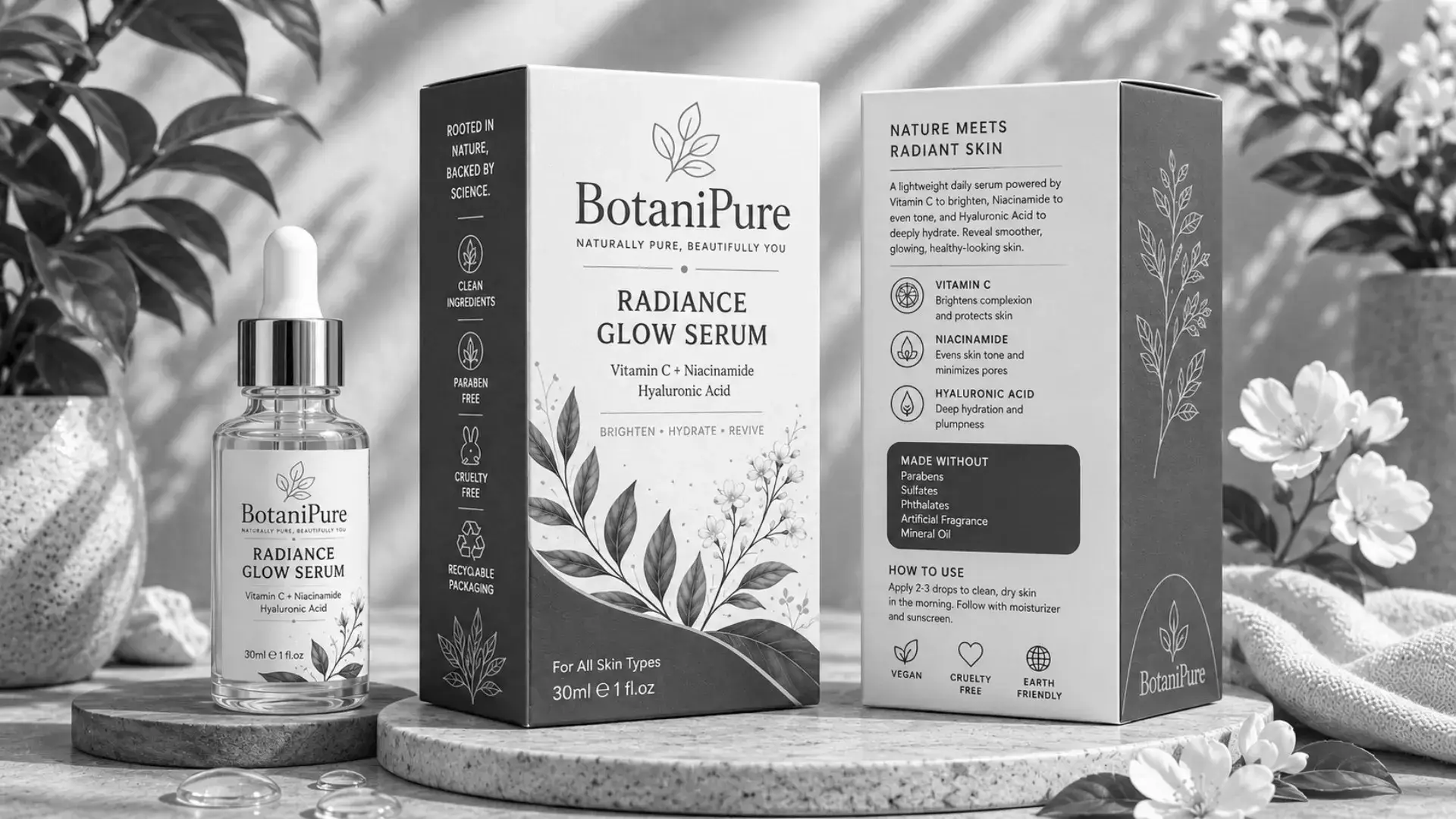
Choosing the right custom packaging design means matching your product’s structure, your customer’s expectations, and your brand identity, all at once. Get one of those wrong, and even a great product can fail on the shelf. These tips will help you make smarter packaging decisions from the start.
Key Takeaways
- Always sort your packaging structure first. The material and format must match your product’s weight, fragility, and transit needs before you think about design.
- Design for your customer, not your product. Your packaging should feel right to the person opening it, whether they’re buying online or in a Woolworths aisle.
- Australian consumers make shelf purchasing decisions in under five seconds (Inside Retail Australia). Colour and typography do the heavy lifting before a single word is read.
- Keep your front panel to one brand name and one key message. Clutter costs you the sale.
- A design that looks right on screen can look completely different once printed. Always work with a designer who understands print specs, bleeds, and material finishes.
Introduction
Walk into any supermarket in Melbourne, and you’ll see hundreds of products competing for the same customer. Most of them will be ignored. The ones that get picked up share something in common: their custom packaging design was built around a real understanding of the product, the customer, and the shelf environment.
Australian businesses, especially small and medium-sized product brands, often underestimate how much packaging decisions affect sales. It’s not just about looking good. It’s about making the right choice at the right time for the right audience. This guide covers the practical things that actually matter when you’re choosing a custom packaging design.
Does your product type determine your packaging?
Yes. Your product’s physical properties should drive your first packaging decision, before you think about colours, fonts, or branding.
Is your product fragile? Then your packaging needs structural integrity, not just a pretty box. Is it liquid? Then, material and seal type matter more than visual design at this stage. Heavy products need packaging that can handle the weight through transport and on the shelf. Products with sharp edges need internal protection.
Australian retailers and logistics partners have strict expectations around packaging durability. A product that arrives damaged reflects poorly on your brand, regardless of how good the design looks. According to Shopify Australia, product packaging must perform in transit before it can perform as a brand asset.
Get the structure right first. Then bring in design.
This is something we see with clients across Melbourne and regional Victoria. The businesses that skip structural planning early on often spend more fixing problems later, whether that’s reprints, stock damage, or returned products.
How do you design packaging that connects with your customer?
Think about your customer first, not your product. The best custom packaging design feels instinctively right to the person opening it.
A teenager buying a skincare product thinks differently from a professional buying a supplement. A parent buying a child’s snack responds to different visual cues than a chef buying a specialty ingredient. Your packaging should speak directly to the mindset of the person most likely to buy it.
Consider where they shop. If your product is sold online through Shopify or Amazon Australia, the packaging needs to perform in an unboxing context, not just on a shelf. If it’s in a Woolworths or IGA aisle, it needs to win a split-second attention battle against dozens of competitors.
Think about what they value. Australian consumers are increasingly focused on sustainability. According to APCO (the Australian Packaging Covenant Organisation), consumer expectations around recyclable and compostable packaging are now a baseline, not a bonus. If your customer cares about the environment, your packaging materials need to reflect that.
You can learn a lot by simply spending time in the aisles where your product will sit. Look at what’s already there. Look at what stands out. Then ask yourself what your packaging would look like next to those products.
What makes packaging stand out on the shelf?
Packaging that stands out does the opposite of what’s around it, without looking out of place in the category.
If every competitor uses dark, moody colours, a clean white pack will stand out. If everyone uses illustrated labels, bold typography might cut through. The goal is not to be different for the sake of it. The goal is to be immediately noticeable to the right person.
Colour is the fastest signal your packaging sends. It communicates mood, quality level, and category fit before the customer reads a single word. According to Inside Retail Australia, Australian consumers make purchasing decisions at the shelf level in under five seconds. Your colour palette needs to do a lot of work in a very short window.
Typography is the next signal. Clear, legible fonts communicate confidence. Overly decorative fonts can look unprofessional or confusing at small sizes. Always check your type at print scale, not just on screen.
Our packaging design team at SAGA Designs works through this competitive shelf audit with every client before touching a single design element. It’s one of the most valuable steps in the process and one that most businesses skip.
How do you keep your packaging front panel simple and effective?
One brand name. One key message. That’s the rule for your front panel.
Customers make decisions fast. If they have to read a paragraph to understand what you’re selling, they’ve already moved on to the next product. The front of your packaging should answer one question instantly: what is this and why should I want it?
Secondary information, ingredients, instructions, certifications, and legal text all belong on the back or sides. Resist the urge to fill every surface with copy. Negative space is a design tool. It signals confidence and quality.
This is especially important for product brands selling through Australian grocery and health retail. Category managers and buyers at major retailers look at your front panel first. If it’s cluttered or confusing, your product is less likely to get listed.
If you’re working on your first custom packaging design, write down the one thing you want a customer to remember about your product. Build your front panel around that single idea.
Why does print production knowledge matter in packaging design?
A design that looks perfect on a screen can look completely different once it’s printed. This is one of the most common and costly mistakes in packaging design.
Colours shift between screen (RGB) and print (CMYK). What looks bright and vibrant on your monitor may appear dull or slightly off-tone on the finished box or label. Gradients, in particular, often don’t translate well to print without specific preparation.
Bleeds, safe zones, and dieline specifications are not optional. A graphic designer who works purely in digital formats may not understand that packaging artwork needs to extend beyond the cut line, or that certain elements need to stay a minimum distance from the edge.
Material choice also affects how the ink looks. Glossy lamination brightens colours. Matte lamination softens them. Kraft paper absorbs ink differently from white-coated board. If your designer hasn’t worked across these materials, you’re likely to get surprises at the proofing stage.
At SAGA Designs, every packaging project goes through print-ready checks before artwork is finalised. This saves clients from expensive reprints and delays, which are common problems when packaging design is handed to a generalist rather than a specialist with print experience.
Our packaging design services are built around this end-to-end approach, from initial concept through to production-ready files.
Does custom packaging have to be expensive?
No. But it does have to be right.
Good custom packaging design doesn’t require a massive budget. It requires clear thinking about your product, your customer, and your brand. If you get those three things aligned, you can produce effective packaging at a range of price points.
Where businesses waste money is in getting it wrong the first time and having to redo it. A poorly briefed designer, a rushed process, or a template-based approach that doesn’t account for your specific product category will almost always cost more in the long run.
For small and medium Australian businesses, the smartest approach is to invest in getting the strategy right first. Know your customer. Know your shelf. Know your print specifications. Then brief a designer who understands all three.
Our brand identity services can help you build the visual foundation your packaging needs, whether you’re launching a new product or refreshing an existing one.
You don’t need to spend a fortune. You need to spend it in the right places.
Frequently Asked Questions
What are the most important elements of custom packaging design for small businesses in Australia?
The most important elements are structural fit, customer alignment, and print accuracy. Your packaging needs to protect the product, communicate clearly to your target customer, and look consistent once printed. For Australian businesses, sustainability is increasingly important too, with APCO guidelines shaping what consumers and retailers expect from packaging materials.
How do I make my product packaging stand out on Australian supermarket shelves?
Study the shelf your product will sit on. Look at what competitors are doing with colour, typography, and layout. Then design your packaging to do the opposite in the most relevant way. Strong colour contrast, clear brand naming, and a single bold front-panel message are the most reliable ways to win attention in under five seconds.
What is the difference between packaging design for online and in-store products in Australia?
Online packaging needs to perform in an unboxing context, where the experience of opening matters. In-store packaging needs to win a shelf battle in seconds. For online, consider interior presentation, tissue paper, inserts, and the structural integrity for courier handling. For in-store, shelf presence, colour visibility, and front-panel clarity are the priorities. Many Australian brands now design for both.
How much does custom packaging design cost for a small business in Australia?
Custom packaging design costs vary widely based on scope and complexity. A basic label or box design from a specialist agency in Australia typically starts from a few hundred dollars, while a full packaging system design with 3D visualisation and print production management can range into the thousands. The right investment depends on your product category, retail channel, and volume. Avoid the cheapest option if your product is competing on a retail shelf.
Do I need to consider sustainability when choosing packaging design in Australia?
Yes. The Australian Packaging Covenant Organisation (APCO) has set national targets for packaging to be recyclable, reusable, or compostable. Major Australian retailers, including Woolworths and Coles, are pushing suppliers toward sustainable materials. Beyond regulation, Australian consumers increasingly expect brands to make responsible packaging choices. Sustainable packaging is now a baseline expectation, not a point of difference.
Should I use 3D product visualisation before printing my custom packaging?
Yes, especially for new products or significant redesigns. 3D product visualisation lets you see exactly how your packaging will look in real-world conditions, on shelf, photographed for e-commerce, and from different angles, before you commit to a print run. It saves money by catching design issues early and gives you marketing-ready images before physical stock arrives. SAGA Designs offers 3D product modelling as part of our packaging workflow.
Conclusion
Choosing the right custom packaging design comes down to understanding three things: your product, your customer, and your brand. When those three are aligned, packaging becomes one of the most powerful commercial tools a business has.
Australian businesses have more packaging options than ever, but also more competition on the shelf and online. Getting packaging right the first time saves money, protects your brand, and gives your product a real chance to win the customer’s attention.
Ready to create packaging that actually sells? SAGA Designs helps businesses across Melbourne and Australia build product packaging that stands out in the right way. Get in touch and let’s talk about your product.